Wavelength
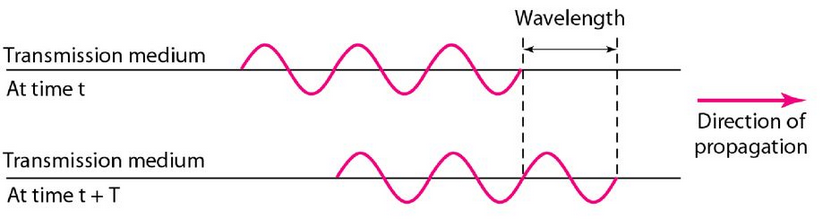
Wavelength is another characteristic of a signal traveling through a transmission medium. Wavelength binds the period or the frequency of a simple sine wave to the propagation speed of the medium. While the frequency of a signal is independent of the medium, the wavelength depends on both the frequency and the medium. Wavelength is a property of any type of signal.
In data communications, we often use wavelength to describe the transmission of light in an optical fiber. The wavelength is the distance a simple signal can travel in one period.
Wavelength can be calculated if one is given the propagation speed (the speed of light) and the period of the signal.
Formula:
-
the propagation speed of electromagnetic signals depends on the medium and on the frequency of the signal
-
for example, in a vacuum, light is propagated with a speed of ; the speed is lower in air and even lower in cable
-
wavelength is normally measured in micrometers (microns) instead of meters
|
Wavelength of red light (frequency = ) in air is: |
In coaxial or fiber-optic cable, however, the wavelength is shorter ( ) because the propagation speed in the cable is decreased.
Typical wave speeds
-
Light in air or vacuum:
299,792,458 m/s -
Light in water:
224,901,000 m/s -
Sound in air:
343.2 m/s -
Sound in water (20 °C):
1,481 m/s