Phase
The term phase describes the position of the waveform relative to time 0. If we think of the waves as something that can be shifted backward or forward along the time axis, phase describes the amount of that shift.
Phase is measured in degrees or radians.
-
rad
-
is rad
-
rad is
Phase Shifts:
-
a phase shift of corresponds to a shift of a complete period
-
a phase shift of corresponds to a shift of one-half of a period
-
a phase shift of corresponds to a shift of one-quarter of a period
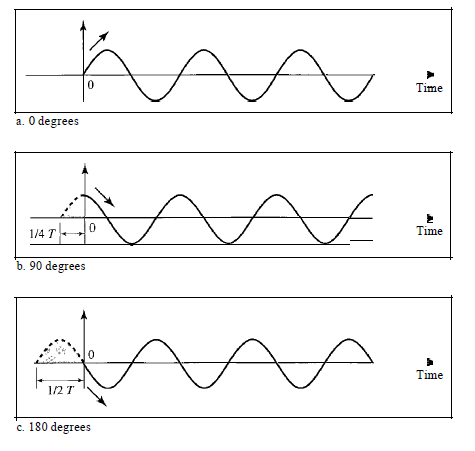
|
-
(a) A sine wave with a phase of starts at time 0 with a zero amplitude. The amplitude is increasing.
-
(b.) A sine wave with a phase of starts at time 0 with a peak amplitude. The amplitude is decreasing.
-
(c.) A sine wave with a phase of starts at time 0 with a zero amplitude. The amplitude is decreasing.
Another way to look at the phase is in terms of shift or offset. We can say that:
-
(a.) A sine wave with a phase of is not shifted.
-
(b.) A sine wave with a phase of is shifted to the left by 1/4 cycle. However, note that the signal does not really exist before time 0.
-
(c.) A sine wave with a phase of is shifted to the left by 1/2 cycle. However, note that the signal does not really exist before time 0.
A sine wave is offset cycle with respect to time 0. What is its phase in degrees and radians
| We know that 1 complete cycle is . Therefore, cycle is rad |