Signal Transmission
Analog and Digital Data
Data can be analog or digital. Analog data refers to information that is continuous; digital data refers to information that has discrete states.
Analog data, such as the sounds made by a human voice, take on continuous values. When someone speaks, an analog wave is created in the air. This can be captured by a microphone and converted to an analog signal or sampled and converted to a digital signal.
Digital data take on discrete values. For example, data are stored in computer memory in the form of 0s and 1s. They can be converted to a digital signal or modulated into an analog signal for transmission across a medium
Analog and Digital Signals
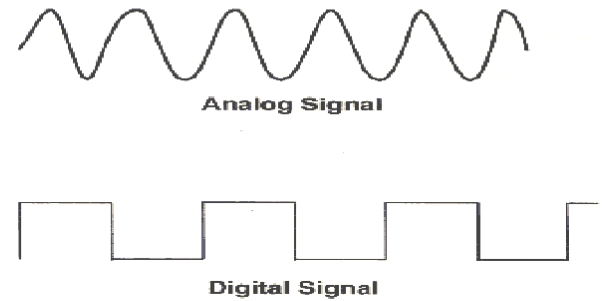
Like the data they represent, signals can be either analog or digital. An analog signal has infinitely many levels of intensity over a period of time. As the wave moves from value A to value B, it passes through and includes an infinite number of values along its path. A digital signal, on the other hand, can have only a limited number of defined values. Although each value can be any number, it is often as simple as 1 and O.
The curve representing the analog signal passes through an infinite number of points. The vertical lines of the digital signal, however, demonstrate the sudden jump that the signal makes from value to value.
|
Both analog and digital signals can take one of two forms: periodic or nonperiodic. Meaning, they can be both periodic or nonperiodic.
A periodic signal completes a pattern within a measurable time frame, called a period, and repeats that pattern over subsequent identical periods. The completion of one full pattern is called a cycle.
A nonperiodic signal changes without exhibiting a pattern or cycle that repeats over time.
In data communications, we frequently use periodic analog signals (because they need less bandwidth), and nonperiodic digital signals (because they can represent variation in data).