Sine Waves
Also known as sinusoidal wave.
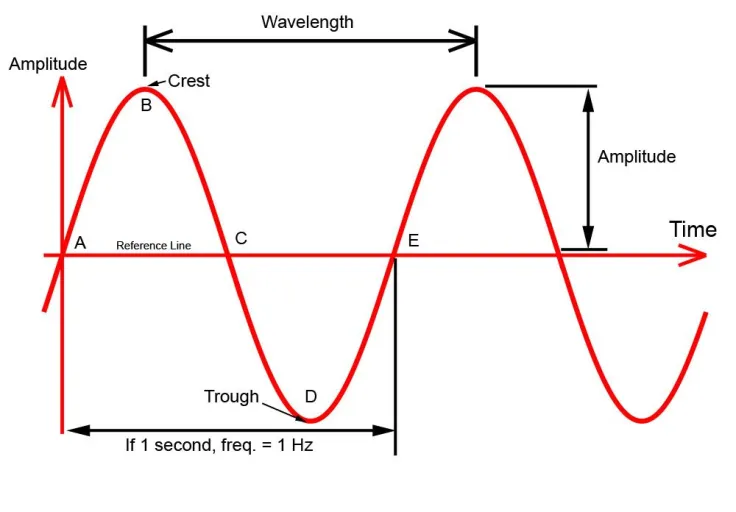
The sine wave is the most fundamental form of a periodic analog signal. When we visualize it as a simple oscillating curve, its change over the course of a cycle is smooth and consistent, a continuous, rolling flow. Each cycle consists of a single arc above the time axis followed by a single arc below it.
A sine wave can be represented by three parameters: the peak amplitude, the frequency, and the phase. These three parameters fully describe a sine wave.
The peak amplitude of a signal is the absolute value of its highest intensity, proportional to the energy it carries. For electric signals, peak amplitude is normally measured in volts.
Applications of Simple Sine Waves
-
power company sends a single sine wave with a frequency of 60 Hz to distribute electric energy to houses and businesses (sine wave carrying energy)
-
send an alarm to a security center when a burglar opens a door or window in the house (sine wave is a signal of danger)
In data communication, if we had only one single sine wave to convey a conversation over the phone, it would make no sense and carry no information; just hear a buzz. A single-frequency sine wave is not useful in data communications; we need to send a composite signal, a signal made of many simple sine waves.